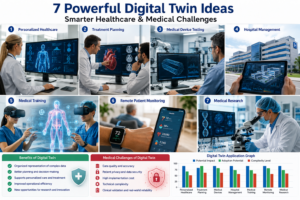
Healthcare technology is changing rapidly, and Digital Twin technology is becoming an interesting part of this transformation. A Digital Twin is a virtual model that can represent a real object, system, process, or certain patient-related information in a digital environment. In healthcare, this technology is being explored for medical research, treatment planning, hospital management, and personalized care. Along with promising benefits, Digital Twin technology also brings important challenges related to privacy, data accuracy, cost, and clinical validation 7 Powerful Digital Twin Ideas – Smarter Healthcare & Medical Challenges.
Table of Contents
- What Is a Digital Twin?
- 7 Powerful Digital Twin Ideas
- Benefits of Digital Twin
- Medical Challenges of Digital Twin
- Digital Twin Comparison Table
- Frequently Asked Questions
- Conclusion
What Is a Digital Twin?
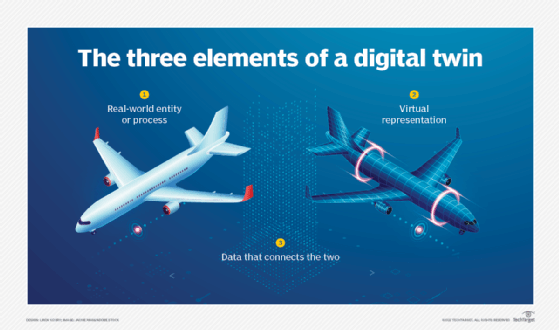
A Digital Twin is a digital representation of a real-world object, process, system, or environment. It uses data to help researchers and professionals understand how something works and how it may respond under different conditions.
Digital twins have already been explored in areas such as engineering and manufacturing. In healthcare, the same basic concept is being studied for medical applications.
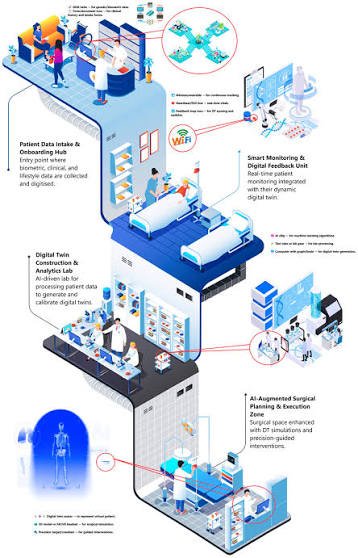
Healthcare digital models may combine information from medical imaging, monitoring devices, clinical records, and other relevant sources. These models can potentially help researchers and healthcare professionals understand complex medical situations in new ways.
However, a Digital Twin should not automatically be considered a perfect virtual copy of a patient or medical system. Its usefulness depends on the quality of the available data, the design of the model, and the specific healthcare application 7 Powerful Digital Twin Ideas – Smarter Healthcare & Medical Challenges.
7 Powerful Digital Twin Ideas
1. Digital Twin for Personalized Healthcare
A Digital Twin can support the growing interest in personalized healthcare. Every patient can respond differently to a disease or treatment, making individual patient information important for healthcare planning.
A patient-specific digital model could potentially help researchers study different treatment possibilities and understand how certain changes might affect an individual situation 7 Powerful Digital Twin Ideas – Smarter Healthcare & Medical Challenges.
Digital Twin and Personalized Care
7 Powerful Digital Twin Ideas – Smarter Healthcare & Medical Challenges One potential advantage of Digital Twin technology is the ability to organize patient-specific information into a digital model. This could help healthcare professionals consider individual characteristics instead of relying only on general patterns.
However, digital models should support professional medical judgment rather than replace it.
2. Digital Twin for Treatment Planning
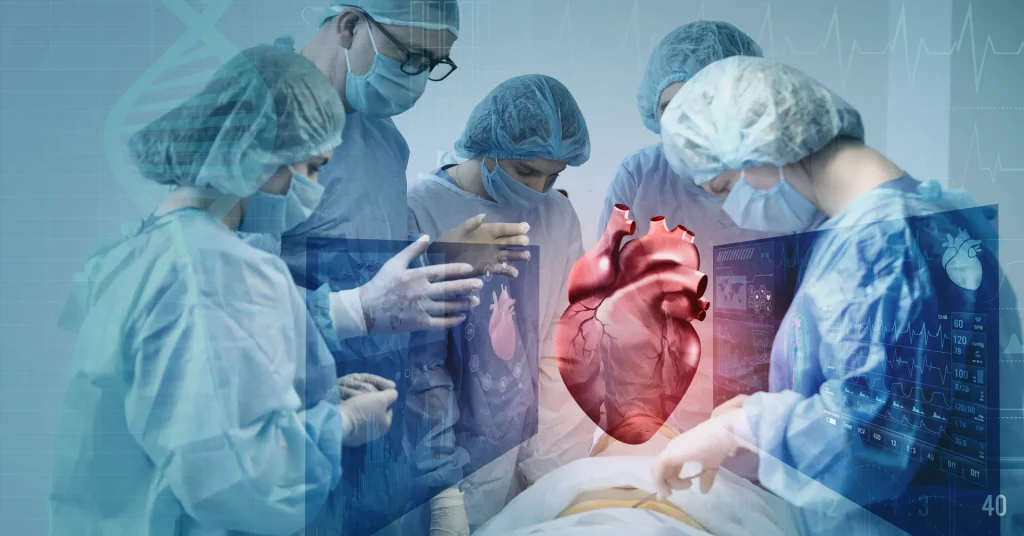
Digital Twin technology is also being explored for treatment planning. Before complex medical procedures, healthcare professionals may need to study patient anatomy, medical images, and other relevant information.
A digital model could provide an additional environment for studying possible treatment scenarios. Researchers can explore how different approaches might work under specific conditions.
Digital Twin Medical Simulation
Medical simulation can provide useful planning support, but it should not be treated as a guaranteed prediction of what will happen in the real world 7 Powerful Digital Twin Ideas – Smarter Healthcare & Medical Challenges.
Clinical expertise, patient-specific factors, and appropriate medical testing remain essential.
3. Digital Twin for Medical Device Testing
7 Powerful Digital Twin Ideas – Smarter Healthcare & Medical Challenges Medical devices often require extensive testing before they are used in real healthcare environments. Digital Twin technology may offer another way to study how devices could perform under different conditions.
Researchers can create digital representations of medical devices and examine possible operating scenarios through simulation.
Digital Twin Device Research
A reliable digital model could provide additional insights during the early stages of medical device development. It may help researchers identify possible design issues and compare different approaches.
However, digital simulations do not eliminate the need for physical testing, safety assessments, or regulatory requirements 7 Powerful Digital Twin Ideas – Smarter Healthcare & Medical Challenges.
4. Digital Twin for Hospital Management
Digital Twin technology can also be applied to hospital operations. Hospitals involve many interconnected systems, including beds, equipment, staff, departments, and patient movement.
A digital hospital model could help management teams study how changes in one part of the system might affect another.
Digital Twin Hospital Operations
Hospital administrators could potentially use simulations to examine patient flow, resource allocation, equipment use, and operational bottlenecks.
This could support better planning and help organizations understand possible outcomes before making major operational changes.
5. Digital Twin for Medical Training
Medical education already uses simulations to help students and professionals learn complex procedures. Digital Twin technology could potentially make these training environments more detailed and interactive.
Students could study simulated medical situations and practice understanding different scenarios in a controlled digital environment 7 Powerful Digital Twin Ideas – Smarter Healthcare & Medical Challenges.
Digital Twin Learning Benefits
One possible advantage is repeatable learning. Students may be able to study the same type of scenario multiple times without directly affecting a real patient One possible advantage is repeatable learning. Students may be able to study the same type of scenario multiple times without directly affecting a real patient
Still, digital simulation should complement supervised clinical education rather than replace hands-on medical experience 7 Powerful Digital Twin Ideas – Smarter Healthcare & Medical Challenges.
6. Digital Twin for Remote Patient Monitoring
Remote healthcare increasingly depends on connected devices and digital monitoring systems. Digital Twin technology could potentially work alongside these systems to organize and analyze patient-related information.
Wearable devices and other monitoring technologies can generate continuous streams of data. A digital model could help researchers explore patterns within this information.
Digital Twin and Health Monitoring
The potential benefit is improved understanding of changes in a patient’s condition. However, data accuracy, privacy, cybersecurity, and timely professional review remain extremely important.
A digital system should not be treated as a replacement for appropriate medical evaluation.
7. Digital Twin for Medical Research
Medical research often involves large and complex datasets. Digital Twin technology can provide researchers with new ways to represent and simulate complex biological or healthcare systems.
Researchers can explore disease progression, treatment scenarios, medical processes, and other factors through digital modeling.
Digital Twin Research Opportunities
As datasets, computing systems, and modeling techniques improve, healthcare digital twins may become more sophisticated.
However, scientific validation remains essential. A promising digital model should not automatically be considered clinically effective without appropriate research and evidence 7 Powerful Digital Twin Ideas – Smarter Healthcare & Medical Challenges.
Benefits of Digital Twin
One of the major potential benefits of Digital Twin technology is its ability to represent complex healthcare information in an organized digital environment.
Researchers and healthcare professionals may use digital models to study different scenarios without immediately changing a real-world system.
Personalized healthcare, treatment planning, hospital management, medical training, device development, and research are all areas where digital twins may provide useful opportunities.
Another potential benefit is improved planning. If a healthcare organization can simulate a process digitally, it may be possible to identify certain problems before implementing changes in the real environment.
However, these benefits are not automatically guaranteed. The real value of a Digital Twin depends on data quality, model accuracy, validation, security, and the specific healthcare use case.
Medical Challenges of Digital Twin
Despite its potential, Digital Twin technology also presents several important medical challenges.
Data quality is one of the biggest concerns. If a model is built using incomplete, outdated, or inaccurate information, its results may not accurately represent the real situation.
Patient privacy is another major concern. Healthcare data can contain highly sensitive information, so digital twin systems need strong security and responsible data management.
Cost and technical complexity can also make implementation difficult. Healthcare organizations may need specialized software, computing infrastructure, data systems, and trained professionals.
Clinical validation is equally important. Medical digital twins should be carefully evaluated before their results are used to support important healthcare decisions 7 Powerful Digital Twin Ideas – Smarter Healthcare & Medical Challenges.
Digital Twin and Patient Data Privacy
A healthcare Digital Twin may involve information collected from medical records, imaging systems, sensors, and connected devices. This creates important questions about how patient data is collected, stored, shared, and protected.
Healthcare organizations need clear rules for data access and appropriate security measures. Patients should also have appropriate protections around the use of their personal health information.
As digital healthcare systems become more advanced, privacy and cybersecurity need to be considered from the beginning rather than added later 7 Powerful Digital Twin Ideas – Smarter Healthcare & Medical Challenges.
Digital Twin Comparison Table
| Digital Twin Application | Main Purpose | Potential Benefit | Main Challenge |
|---|---|---|---|
| Personalized Healthcare | Patient-specific modeling | More tailored planning | Data quality |
| Treatment Planning | Scenario simulation | Better preparation | Clinical validation |
| Medical Devices | Device testing | Design insights | Physical testing |
| Hospital Management | Operations modeling | Resource planning | System complexity |
| Medical Training | Virtual simulation | Repeated learning | Real-world experience |
| Remote Monitoring | Data analysis | Continuous insights | Privacy |
| Medical Research | Digital modeling | New research methods | Scientific validation |
Digital Twin Application Graph
The following chart provides a conceptual comparison of the seven healthcare applications discussed in this article. These values are illustrative and do not represent clinical effectiveness, market size, or scientific measurements.
The purpose of this graph is to provide a simple visual comparison of the potential applications of Digital Twin technology. Actual healthcare value should be determined through research, validation, and real-world evidence 7 Powerful Digital Twin Ideas – Smarter Healthcare & Medical Challenges.
Future of Digital Twin in Healthcare
The future of Digital Twin technology in healthcare could become more advanced as artificial intelligence, medical imaging, connected devices, cloud computing, and data analytics continue to develop.
Future healthcare systems may combine information from multiple sources to create more detailed digital models. These systems could potentially support researchers and healthcare professionals with additional insights for planning and analysis.
At the same time, technological progress needs to be balanced with patient safety, privacy, ethics, and scientific validation.
The goal should not simply be to create more advanced digital models. The goal should be to develop technology that provides meaningful and safe support for healthcare professionals and patients.
Frequently Asked Questions About Digital Twin
What Is a Digital Twin in Healthcare?
A healthcare Digital Twin is a digital representation of a medical system, process, device, or patient-related information that can be used for analysis, simulation, and research 7 Powerful Digital Twin Ideas – Smarter Healthcare & Medical Challenges.
How Can Digital Twin Help Doctors?
Digital Twin technology may support doctors and healthcare teams with treatment planning, simulation, data analysis, and understanding complex medical information. It is not a replacement for professional medical judgment.
Is Digital Twin Used for Patients?
Patient-related digital twin applications are an active area of research and development. These models may potentially support personalized healthcare, monitoring, and treatment planning.
What Are the Biggest Digital Twin Challenges?
Major Digital Twin challenges include data accuracy, patient privacy, cybersecurity, implementation costs, technical complexity, and clinical validation 7 Powerful Digital Twin Ideas – Smarter Healthcare & Medical Challenges.
Can Digital Twin Replace Doctors?
No. Digital Twin technology is a digital modeling approach. Medical diagnosis and treatment decisions require qualified healthcare professionals and appropriate clinical evidence.
Is Digital Twin the Future of Healthcare?
Digital Twin technology is a promising area of healthcare research, but its long-term impact will depend on scientific evidence, successful implementation, patient safety, privacy protection, and measurable clinical value.
Conclusion
Digital Twin technology represents an innovative approach that could create new possibilities across healthcare. From personalized care and treatment planning to medical device testing, hospital management, training, remote monitoring, and research, digital models may help professionals study complex healthcare systems in new ways.
7 Powerful Digital Twin Ideas – Smarter Healthcare & Medical Challenges However, technology alone cannot solve every medical problem. Data accuracy, patient privacy, cybersecurity, cost, clinical validation, and professional oversight remain essential 7 Powerful Digital Twin Ideas – Smarter Healthcare & Medical Challenges.
As AI and digital healthcare technologies continue to develop, Digital Twin systems may become more sophisticated and useful. The most valuable future applications will be those that combine innovation with safety, reliable evidence, responsible data use, and meaningful improvements in patient care 7 Powerful Digital Twin Ideas – Smarter Healthcare & Medical Challenges.
Leave a Reply