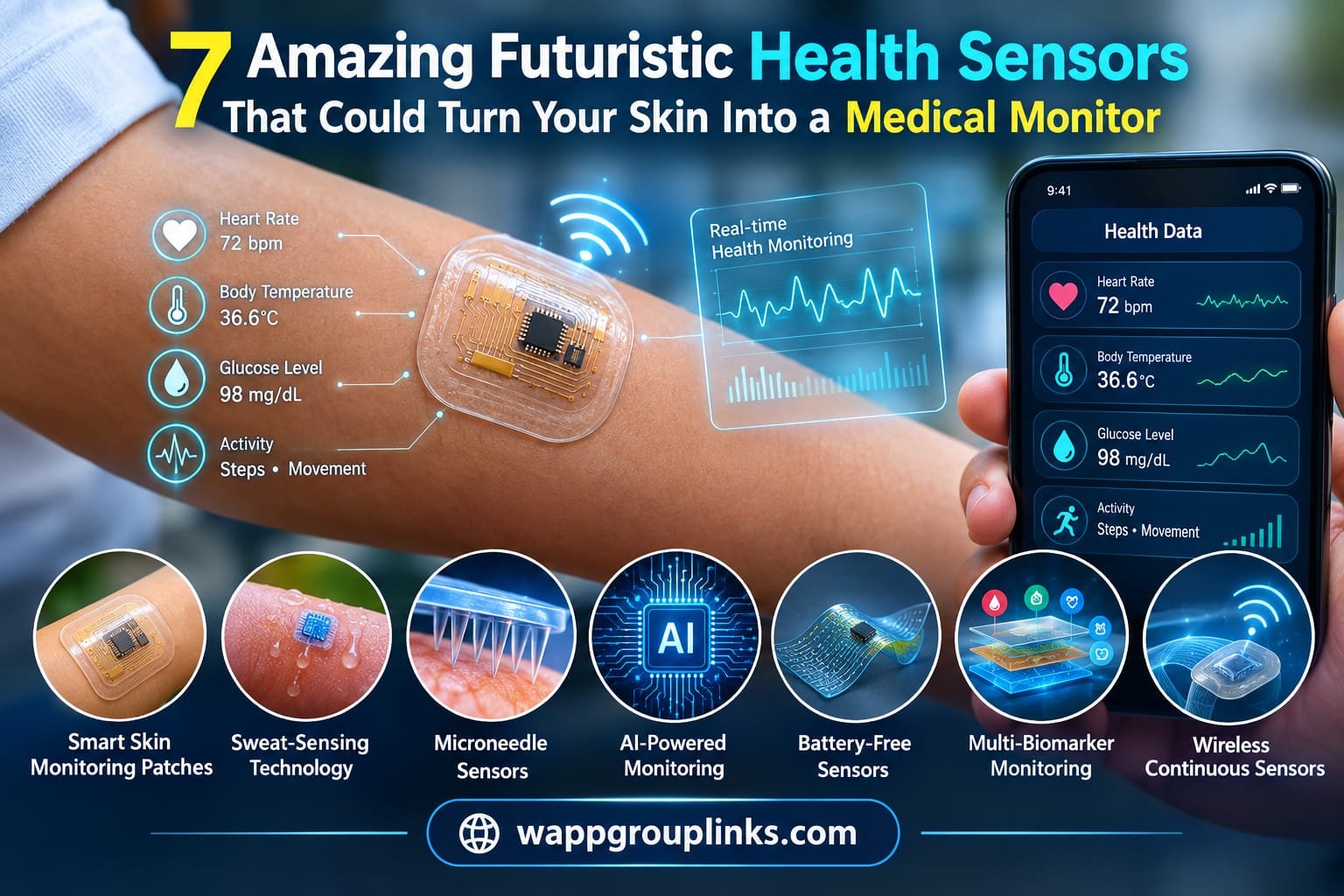
Healthcare is gradually moving beyond traditional checkups and occasional laboratory tests. In the future, small sensors could help collect health information continuously while a person goes about normal daily activities.
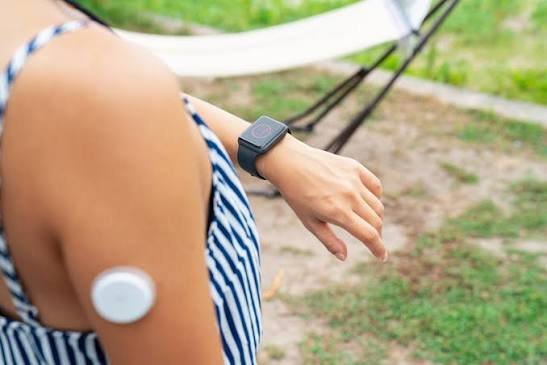
This is where Futuristic Health Sensors are becoming particularly interesting. Researchers are developing flexible patches, wearable biosensors, microneedle systems, and other technologies that can monitor physiological or biochemical signals closer to where they are produced.
Recent research has shown that wearable and implantable biosensors can be designed to monitor biological signals continuously, while artificial intelligence can help process the large amounts of data produced by these devices. However, researchers still face challenges involving accuracy, energy supply, motion interference, privacy, and clinical validation.
The technology is therefore promising, but many of these systems are still being researched rather than being routine medical products.
Table of Contents
- Smart Skin Monitoring Patches
- Sweat-Sensing Health Technology
- Microneedle Health Sensors
- AI-Powered Health Monitoring
- Battery-Free Medical Sensors
- Multi-Biomarker Monitoring
- Wireless Continuous Health Sensors
- Challenges Facing Future Sensors
- What Could Happen Next?
- Frequently Asked Questions
- Conclusion
1. Smart Skin Monitoring Patches
One of the most interesting directions in Futuristic Health Sensors is the development of smart patches that can sit directly on the skin.
Unlike ordinary adhesive patches, these systems can contain tiny electronic components and sensing materials. Depending on their design, they may collect information such as body temperature, heart activity, movement, or other physiological signals.
Futuristic Health Sensors Modern research is focusing heavily on flexible and stretchable materials. These materials can better follow the movement of the human body, which is important because skin constantly bends, stretches, and moves.
A future health patch could potentially be worn for extended periods while collecting information continuously.
Instead of visiting a clinic for every measurement, a patient could have selected health signals monitored throughout the day.
However, this does not mean that every future patch will replace conventional medical tests. Laboratory testing and clinical examination will continue to have important roles.
2. Sweat-Sensing Health Technology
Sweat is more than just a sign that the body is warm or physically active. Researchers are investigating whether information contained in sweat can be used for health monitoring.
Recent research published in Nature Biomedical Engineering described a wireless, battery-free wearable sweat sensor designed for multimodal molecular monitoring. The researchers demonstrated simultaneous monitoring of cortisol, urea, lactate, and glucose, with operation validated for up to 21 days in their testing.
This is an exciting direction for Futuristic Health Sensors because sweat could potentially provide information without requiring traditional blood sampling for every measurement.
A future wearable could potentially analyze selected biomarkers while a person exercises, works, or sleeps.
Futuristic Health Sensors Nevertheless, researchers still need to address differences between individuals, environmental conditions, sweat production, calibration, and clinical interpretation.
Therefore, sweat sensors should currently be viewed as an emerging research technology rather than a universal replacement for medical testing.
3. Microneedle Health Sensors
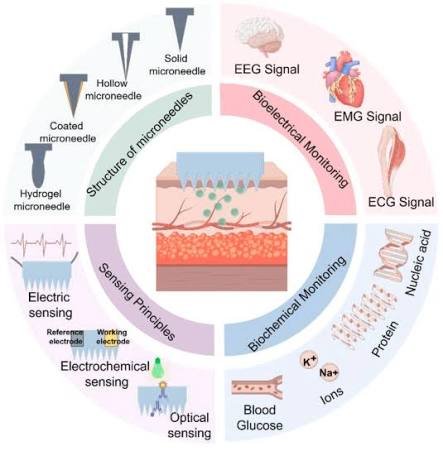
Microneedles sound futuristic, but the basic idea is relatively simple.
Extremely small structures can interact with the skin and access interstitial fluid, which contains biological information beneath the skin. Researchers are investigating ways to use these tiny structures for continuous monitoring.
A 2026 review in Biosensors and Bioelectronics describes wearable microneedle sensors as an emerging technology for continuous interstitial-fluid monitoring. Potential applications discussed include chronic disease management, early disease detection, and therapeutic drug monitoring.
Other 2026 research has gone further. One study reported a microneedle-based device capable of real-time monitoring of cardiac biomarkers in animal models, including rats and pigs.
These developments show why Futuristic Health Sensors could become an important area of medical-device research.
However, animal results should not be interpreted as proof that the same technology is ready for routine human healthcare.
Clinical validation will still be required.
4. AI-Powered Health Monitoring
Sensors can collect enormous amounts of information, but collecting data is only one part of the challenge.
The next question is: How can all this information be understood?
Artificial intelligence could help process large streams of sensor data. Algorithms may be used to identify patterns, remove certain types of noise, or help researchers interpret changes over time.
A 2026 review in npj Flexible Electronics specifically discusses the integration of AI with wearable and implantable biosensors for continuous health monitoring. It also highlights challenges involving motion artifacts, energy autonomy, data privacy, and clinical interpretability.
This combination could make Futuristic Health Sensors more useful in the future.
For example, instead of simply showing thousands of measurements, a system could organize the data into understandable trends for clinicians or users.
Still, AI should not automatically be treated as a doctor. Medical decisions require appropriate clinical evidence, oversight, and validation.
5. Battery-Free Medical Sensors
A major problem with wearable technology is power.
A sensor can be extremely small and accurate, but it still needs energy to operate. Batteries add size, weight, maintenance requirements, and other engineering challenges.
This is why battery-free and energy-autonomous sensors are attracting attention.
In 2026, researchers reported a wearable microneedle system that combined biomarker sensing with energy harvesting from mechanical movement. The system was designed to monitor sodium, potassium, calcium, pH, and glucose in interstitial fluid while using mechanical energy to help power data transmission.
This concept could make future Futuristic Health Sensors more convenient.
For example, body movement could potentially contribute to powering a wearable system rather than requiring frequent battery replacement.
However, energy harvesting also has limitations. The amount of energy available from normal movement can vary significantly.
Therefore, efficient electronics and low-power communication will remain important.
6. Multi-Biomarker Monitoring
Another major direction is the ability to measure several biological signals using one wearable platform.
Futuristic Health Sensors Instead of creating a separate device for every measurement, researchers are exploring systems that can monitor multiple biomarkers simultaneously.
This approach could make future health monitoring more comprehensive.
For example, one platform could potentially combine physiological measurements with biochemical information. Temperature, movement, electrical signals, and selected chemical biomarkers could then be considered together.
This is one reason Futuristic Health Sensors could become more advanced than today’s simple fitness trackers.
Recent wearable research has already demonstrated systems capable of detecting multiple biomarkers. The 2026 sweat-sensing study mentioned earlier, for example, demonstrated simultaneous monitoring of several molecular targets.
The challenge is that every additional measurement can increase system complexity.
Sensors must remain accurate, stable, comfortable, and safe while operating together.
7. Wireless Continuous Health Sensors
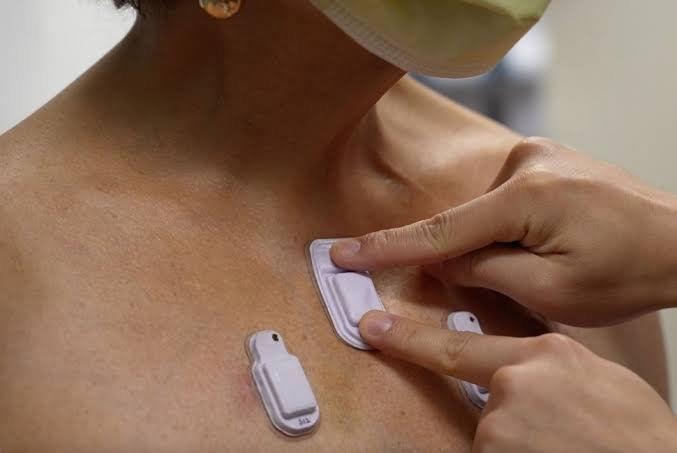
Future medical sensors may also become increasingly wireless.
Wireless communication could allow data to move from a wearable sensor to a smartphone, computer, or clinical system without requiring physical connections.
This could be particularly useful for remote monitoring.
Futuristic Health Sensors A person might wear a sensor at home while selected information is transmitted to a healthcare platform. Doctors could then potentially review trends without requiring the patient to visit a clinic for every routine measurement.
Researchers are already combining sensing systems with wireless transmission. For example, recent microneedle research has demonstrated wireless readout approaches for monitoring interstitial-fluid chemistry.
However, wireless healthcare creates another major concern: data security.
Health information is highly sensitive. Future devices will therefore need strong privacy and cybersecurity protections alongside accurate sensors.
Challenges Facing Future Sensors
Despite the exciting progress, Futuristic Health Sensors still face several challenges.
Accuracy
A sensor needs to produce reliable measurements under real-world conditions, not just inside a controlled laboratory.
Motion
Human movement can interfere with sensor readings. Walking, exercising, sweating, and stretching the skin can all affect measurements.
Energy
Small devices still need power. Battery life and energy harvesting remain important engineering problems.
Comfort
A medical wearable may need to remain on the body for hours or days. It therefore needs to be lightweight, flexible, and comfortable.
Privacy
Continuous monitoring creates large amounts of personal health data. That information must be protected.
Clinical Validation
Perhaps most importantly, promising laboratory results need to be validated through appropriate clinical studies before a technology can be considered for routine medical use.
These challenges are also highlighted in recent research reviews covering wearable biosensors and their path toward real-world healthcare.
What Could Happen Next?
The next generation of Futuristic Health Sensors could become smaller, softer, smarter, and more energy efficient.
Instead of looking like traditional electronic devices, some sensors may become thin patches that blend into the skin.
Futuristic Health Sensors Others could use microneedles to access interstitial fluid. Some could analyze sweat. Others could combine several sensing methods into one platform.
AI could then help organize the information.
The long-term goal is not simply to collect more data. The real objective is to collect useful and reliable information that can support healthcare decisions.
That distinction is important.
More data does not automatically mean better healthcare. Data needs to be accurate, clinically meaningful, securely handled, and properly interpreted.
Frequently Asked Questions
What are Futuristic Health Sensors?
Futuristic Health Sensors are emerging wearable, flexible, wireless, or minimally invasive technologies designed to monitor physiological or biochemical information continuously or frequently.
Can health sensors detect diseases?
Some emerging sensors are being researched for detecting biomarkers associated with diseases. However, research-stage sensors should not be considered proven diagnostic tools unless they have received appropriate clinical validation and regulatory approval.
Can sensors monitor health through the skin?
Yes, some technologies can measure signals directly from the skin, while microneedle systems can access interstitial fluid beneath the skin. Different technologies measure different types of information.
Can sweat be used for health monitoring?
Researchers are investigating sweat as a source of biomarkers. A 2026 study demonstrated a wireless wearable system capable of monitoring multiple sweat biomarkers, including cortisol, urea, lactate, and glucose.
Will AI be used with future health sensors?
AI is already being researched for processing and interpreting wearable-sensor data. Its role could expand as sensors produce more continuous information.
Are these sensors available for everyone?
Not necessarily. Many advanced systems described in recent research are still experimental or undergoing development and validation. Availability depends on the specific technology and its regulatory status.
Conclusion
Healthcare monitoring could become much more continuous in the future.
Smart patches, sweat sensors, microneedles, wireless devices, energy-autonomous systems, and AI-assisted analysis are creating new possibilities for monitoring the human body.
The most exciting Futuristic Health Sensors may eventually work quietly in the background, collecting selected information without requiring constant attention from the user.
However, the technology is still developing. Accuracy, safety, privacy, energy consumption, comfort, and clinical validation all need to be addressed before many experimental systems can become routine medical tools.
For now, the research shows an interesting direction: healthcare sensors are becoming smaller, more flexible, more connected, and increasingly capable of continuous monitoring.
Leave a Reply