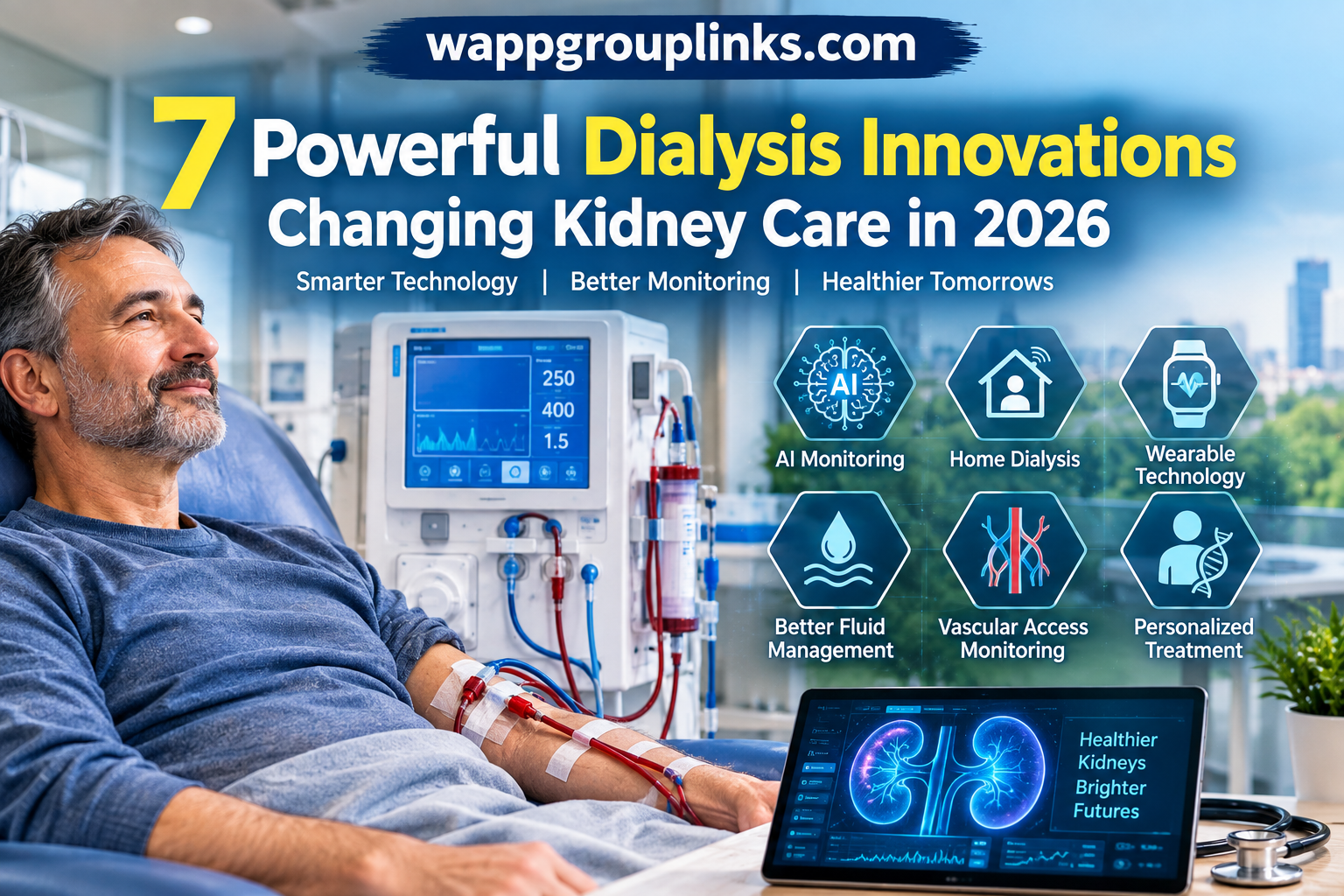
Dialysis Innovations 2026 Kidney failure can make everyday life difficult because regular dialysis may be required to remove waste and extra fluid from the blood. Traditionally, dialysis has been performed with large machines in clinical settings. However, new technologies are now being developed to make kidney care more personalized, connected, and flexible.

In 2026, artificial intelligence, remote monitoring, wearable technologies, and improved home dialysis systems are receiving growing attention. Recent reviews have described AI applications in areas such as blood-pressure prediction, fluid management, anemia care, vascular-access monitoring, and dialysis treatment optimization.
The Dialysis Innovations 2026 discussed in this article show how technology could gradually change the way dialysis is monitored and delivered. However, many of these technologies are still being researched, and they should not be considered replacements for medical treatment or professional advice.
Table of Contents
- What Are Dialysis Innovations 2026?
- AI-Powered Dialysis Monitoring
- Smarter Fluid and Blood Pressure Management
- Remote Monitoring for Home Dialysis
- More Advanced Peritoneal Dialysis
- Wearable Dialysis Technology
- Smarter Vascular Access Monitoring
- Personalized Dialysis Treatment
- Challenges of New Dialysis Technology
- Future of Kidney Care
- Frequently Asked Questions
- Conclusion
What Are Dialysis Innovations 2026?

The term Dialysis Innovations 2026 refers to new and developing technologies that are being studied to improve dialysis care.
These innovations are not limited to one machine or treatment. Instead, several areas are being explored at the same time. Artificial intelligence is being studied for prediction and clinical decision support. Remote monitoring is being used to collect information from patients receiving dialysis at home. Wearable systems and smaller kidney-replacement devices are also being researched.
Importantly, not every technology discussed today has been proven for routine clinical use. Some systems remain experimental, while others are being evaluated in research settings.
Therefore, Dialysis Innovations 2026 should be understood as a broad research area rather than a single new treatment.
1. AI-Powered Dialysis Monitoring
One of the most interesting areas among Dialysis Innovations 2026 is artificial intelligence.
Dialysis produces large amounts of information. Blood pressure, weight, laboratory results, treatment settings, fluid removal, and other measurements can be recorded. These data can potentially be analyzed by machine-learning systems.
Recent research reviews have identified AI applications in predicting intradialytic hypotension, assessing hospitalization and mortality risks, supporting anemia management, and monitoring vascular access.
Instead of relying only on information reviewed after a dialysis session, future systems could potentially identify warning patterns earlier.
For example, a computer model could analyze several patient measurements and identify a pattern associated with falling blood pressure. The information could then be presented to clinicians for review.
However, AI should not be treated as an independent doctor. Recent guidance from the American Society of Nephrology emphasizes clinician oversight, patient benefit, data quality, transparency, and responsible implementation of AI in kidney care.
2. Smarter Fluid and Blood Pressure Management
Another important area in Dialysis Innovations 2026 is smarter management of fluid and blood pressure.
During hemodialysis, fluid is removed from the body. If fluid is removed too quickly or if a patient’s condition changes, blood pressure can fall. This is known as intradialytic hypotension and can create serious problems.
AI and machine-learning models are being studied to predict this complication before it occurs. A recent review reported that several AI models showed promising predictive performance, although further clinical validation is still needed.
In the future, treatment information could potentially be analyzed continuously. As a result, dialysis settings might be adjusted more carefully under clinical supervision.
This approach could make dialysis more personalized. However, real-world benefits still need to be demonstrated through high-quality clinical studies.
3. Remote Monitoring for Home Dialysis
Home treatment is another major part of Dialysis Innovations 2026.
Both home hemodialysis and peritoneal dialysis can be performed outside traditional dialysis centers when patients have been appropriately trained and supported by healthcare professionals.
Remote patient monitoring can allow treatment information to be transferred electronically to a clinical team. Recent 2026 research describes monitoring of information such as blood pressure, weight, treatment data, and peritoneal-dialysis-related measurements.
This can be especially useful because problems may sometimes be identified between clinic visits.
For instance, changes in weight or treatment patterns could be noticed earlier. The healthcare team could then decide whether further assessment is needed.
Therefore, Dialysis Innovations 2026 are not only focused on machines. They are also focused on creating stronger communication between patients and healthcare professionals.
4. More Advanced Peritoneal Dialysis
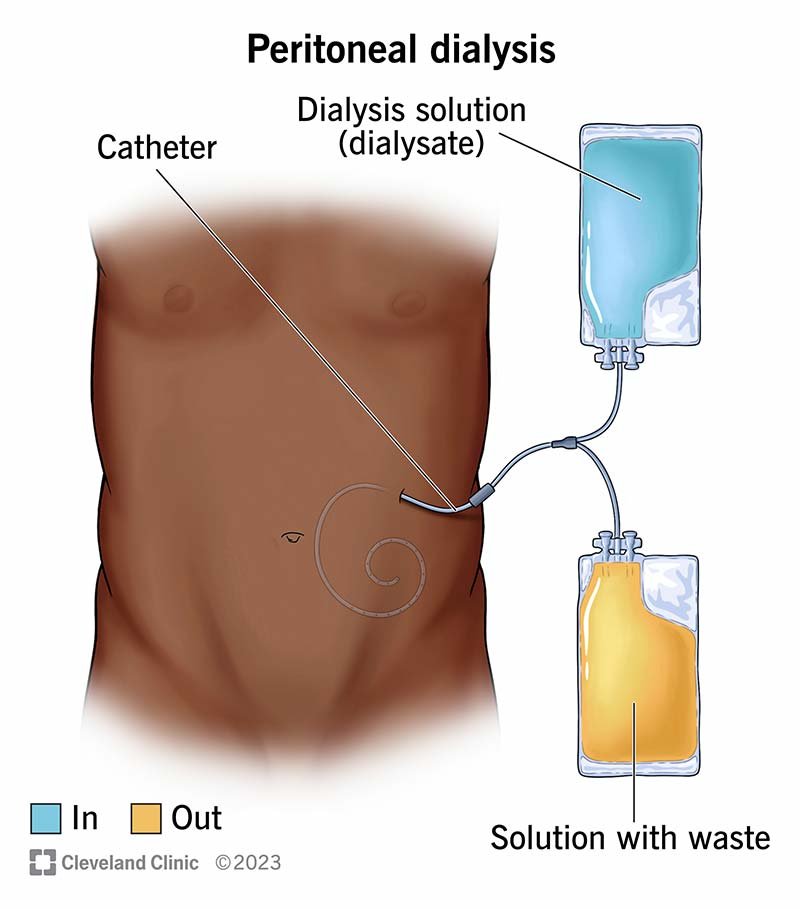
Peritoneal dialysis is another area where Dialysis Innovations 2026 are being explored.
In peritoneal dialysis, the lining of the abdomen is used as a natural filtering membrane. Dialysis fluid is placed into the abdominal cavity and later removed along with waste products and excess fluid.
Because this treatment can generate repeated data over time, it has attracted interest from AI researchers. A 2026 review described peritoneal dialysis as particularly suitable for AI research because it can produce dense and structured longitudinal data.
Future systems could potentially use these data to identify treatment patterns, predict complications, and support personalized decisions.
However, such systems would still need to be carefully validated. Privacy, data quality, algorithmic bias, and clinical integration must also be considered.
5. Wearable Dialysis Technology
One of the most futuristic areas of Dialysis Innovations 2026 is wearable dialysis.
Researchers have been exploring smaller kidney-replacement systems for many years. The idea behind a wearable artificial kidney is to create a device that can be carried or worn rather than relying entirely on a large stationary machine.
Research has focused on miniaturization, new materials, toxin removal, and dialysate regeneration. However, significant technical challenges remain.
A successful wearable system could potentially provide greater freedom of movement for people who require long-term kidney replacement therapy.
Nevertheless, wearable dialysis should not be confused with a widely available treatment. Current research continues to address device size, safety, power requirements, fluid management, vascular access, and reliable toxin clearance.
Thus, this part of Dialysis Innovations 2026 remains an important but developing research field.
6. Smarter Vascular Access Monitoring
Vascular access is another important target for Dialysis Innovations 2026.
Hemodialysis often depends on vascular access, such as an arteriovenous fistula. If access becomes narrowed or develops another problem, dialysis treatment can be affected.
AI and machine learning are now being studied for earlier detection of vascular-access dysfunction. A 2026 systematic review examined AI and machine-learning approaches for predicting arteriovenous fistula problems.
In the future, images and patient data could potentially be analyzed automatically to identify warning patterns.
This could support earlier clinical evaluation. However, an AI prediction should not be considered a diagnosis by itself. Clinical assessment would still be required.
7. More Personalized Dialysis Treatment
Personalization is becoming an important theme in Dialysis Innovations 2026.
Not every patient responds to dialysis in exactly the same way. Age, body composition, blood pressure, laboratory values, remaining kidney function, medications, and other factors can vary greatly.
Because of this, a single approach may not provide the same experience for every patient.
AI systems could potentially combine different types of information and help clinicians identify treatment patterns. Current research is examining personalized fluid management, dialysis adequacy, anemia prediction, and other areas.
This does not mean that a computer will independently select treatment. Instead, the technology could be used as decision support.
As research progresses, more individualized care may become possible while professional medical judgment remains central.
Dialysis Technology Comparison
| Innovation | Main Goal | Current Status |
|---|---|---|
| AI monitoring | Identify risks earlier | Active research and development |
| Remote monitoring | Connect home patients with clinics | Already being used in some settings |
| AI fluid management | Improve treatment personalization | Research and clinical evaluation |
| Wearable dialysis | Increase mobility | Experimental/development stage |
| Vascular access AI | Detect access problems | Research stage |
| Smart peritoneal dialysis | Improve home treatment support | Emerging research |
The table shows why Dialysis Innovations 2026 cover several different technologies rather than one single breakthrough.
Challenges of New Dialysis Technology
Although Dialysis Innovations 2026 offer exciting possibilities, several challenges must be solved.
First, patient data must be protected. AI systems depend on large amounts of health information, so privacy and cybersecurity are important.
Second, AI models must be tested on diverse patient populations. A model trained using limited data may not perform equally well for everyone.
Third, clinicians need to understand how AI recommendations are produced. Systems that cannot be explained clearly may be difficult to trust in important medical decisions.
Fourth, technology must be affordable and accessible. A highly advanced device may have limited impact if it cannot be made available to the patients who need it.
Finally, promising predictions are not enough. Clinical studies must show whether a technology actually improves meaningful patient outcomes.
The American Society of Nephrology has highlighted issues including data quality, equity, transparency, and clinical integration as important considerations for responsible AI use in kidney care.
Future of Kidney Care
The future described by Dialysis Innovations 2026 is likely to involve greater connectivity between patients, machines, clinicians, and digital systems.
Home dialysis could become more connected through remote monitoring. AI could assist with the interpretation of large datasets. Wearable technologies could continue to be researched. Peritoneal dialysis could become increasingly data-driven.
However, the future should not be viewed as a simple replacement of doctors with machines.
Instead, technology may be used to support healthcare professionals and provide them with better information.
Recent research has specifically discussed the possibility of AI-driven decision-support systems that cover different stages of the dialysis journey.
If these systems are proven safe and effective, dialysis care could gradually become more proactive and personalized.
A Simple Future Roadmap
The possible development path of Dialysis Innovations 2026 can be viewed in four stages:
Data Collection → AI Analysis → Clinical Decision Support → Personalized Care
First, information is collected from dialysis machines, laboratory tests, wearable devices, and remote monitoring systems.
Next, AI models can analyze the information and identify patterns.
Then, useful findings can be presented to healthcare professionals.
Finally, if validated through clinical research, these systems could support more personalized care.
This process would still require human oversight at every important stage.
Frequently Asked Questions
1. What are Dialysis Innovations 2026?
Dialysis Innovations 2026 include emerging and developing technologies such as AI-assisted monitoring, remote patient monitoring, personalized treatment systems, vascular-access analysis, and wearable dialysis research.
2. Can AI replace dialysis doctors?
No. Current AI research is primarily focused on prediction, monitoring, and decision support. Professional clinical judgment remains essential.
3. Is wearable dialysis available for everyone?
No. Wearable kidney-replacement technology remains a developing research field, and important technical and safety challenges still need to be addressed.
4. Can dialysis be performed at home?
Yes. Home hemodialysis and peritoneal dialysis can be performed by appropriately selected and trained patients under healthcare supervision. Remote monitoring is also being studied and used to support home dialysis care.
5. How can AI help dialysis patients?
AI may help predict complications, support fluid management, monitor vascular access, assist anemia management, and analyze treatment data. These applications are still being evaluated for clinical effectiveness.
6. Are all new dialysis technologies proven?
No. Some technologies are already used in certain healthcare settings, while others remain experimental or are still undergoing clinical research.
7. What is the future of dialysis?
The future may include more home-based care, remote monitoring, AI-supported decision-making, personalized treatment, and smaller or wearable technologies. However, further research will be needed before many emerging systems can become routine treatments.
Conclusion
The Dialysis Innovations 2026 being studied today show how kidney care could become more connected and personalized.
AI is being investigated for prediction, fluid management, anemia care, vascular-access monitoring, and treatment support. Remote monitoring is helping create stronger connections between home dialysis patients and healthcare teams. At the same time, wearable kidney-replacement devices remain an ambitious area of research.
However, innovation should always be balanced with safety. A promising algorithm or device still needs proper testing before it can be relied upon in routine medical care.
For patients and families, these developments provide an encouraging picture of how kidney care may evolve. Yet treatment decisions should always be made with qualified healthcare professionals.
The most important goal of Dialysis Innovations 2026 is therefore not simply to create smarter machines. It is to develop safer, more personalized, and more patient-centered ways of supporting people living with kidney disease.
Leave a Reply