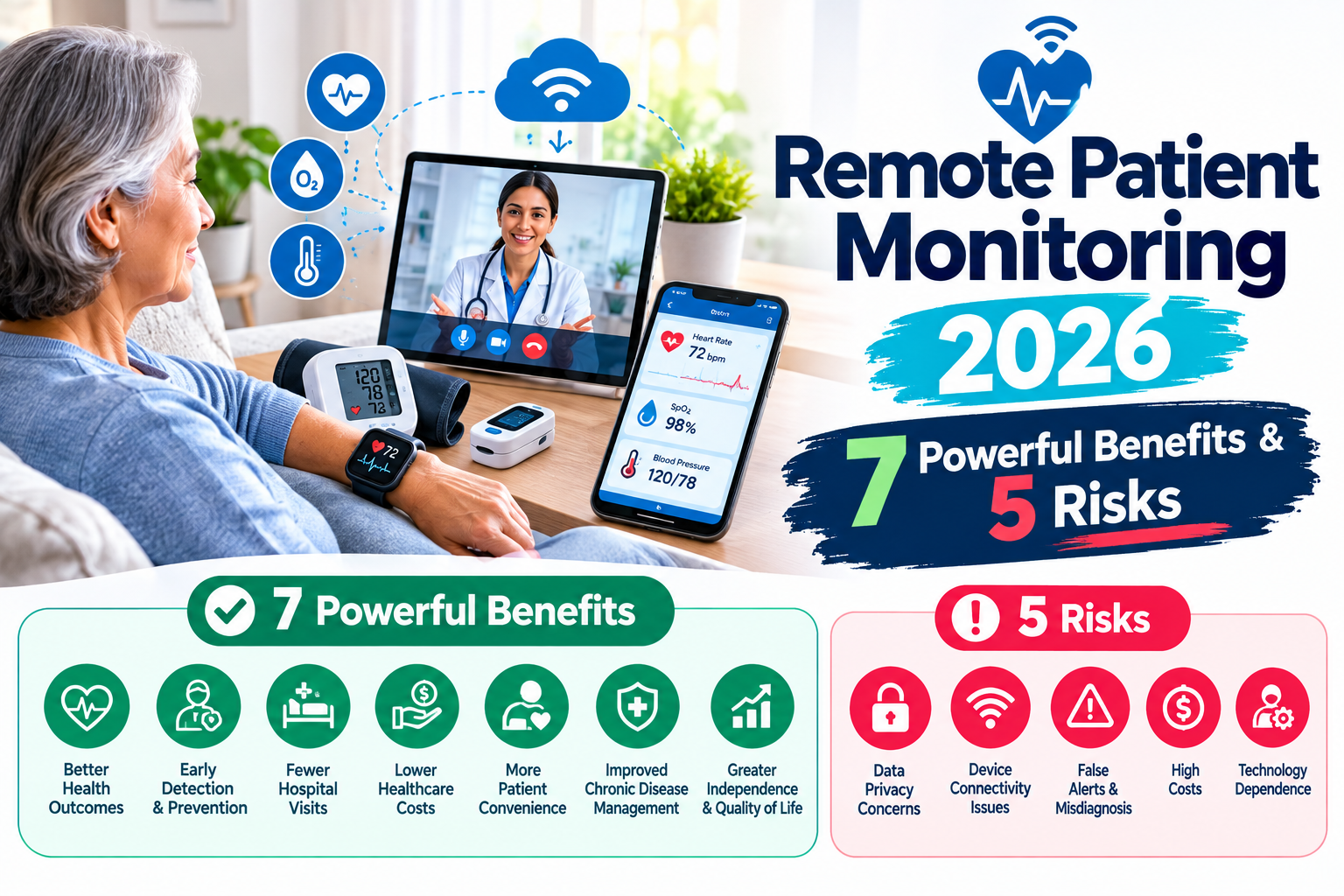
Remote Patient Monitoring is changing the way healthcare teams follow patients outside hospitals and clinics. Instead of requiring patients to visit a healthcare facility for every check, connected devices can collect health information from home and send it to healthcare professionals. This can make ongoing monitoring more convenient and can help doctors notice changes that may need attention.
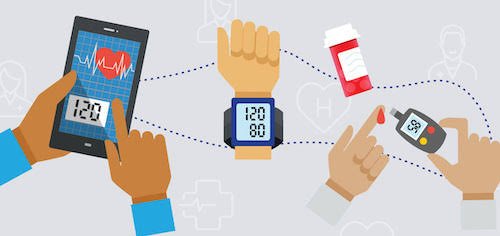
Remote Patient Monitoring can involve devices such as blood pressure monitors, glucose meters, pulse oximeters, wearable heart monitors, and other connected health technologies. The information can then be reviewed by a healthcare team as part of a patient’s care plan.
As healthcare becomes more digital, this approach is becoming especially useful for people who need regular monitoring. However, it also has challenges involving privacy, technology, data quality, cost, and patient participation.
Table of Contents
- What Is Remote Patient Monitoring?
- 7 Powerful Benefits
- 5 Risks
- Comparison Table
- Technology and Development
- Future Outlook
- FAQs
- Conclusion
What Is Remote Patient Monitoring?
Remote Patient Monitoring is a healthcare approach in which patient health data is collected outside a traditional medical facility and transmitted to healthcare professionals for review.
For example, a patient may use a connected blood pressure monitor at home. The device can record readings and transfer them through a smartphone, application, or connected healthcare platform. A healthcare professional can then review the information and decide whether further action is needed.
This approach is different from a simple health app. A proper monitoring program normally involves a healthcare team, a defined care plan, selected measurements, and a process for reviewing the information.
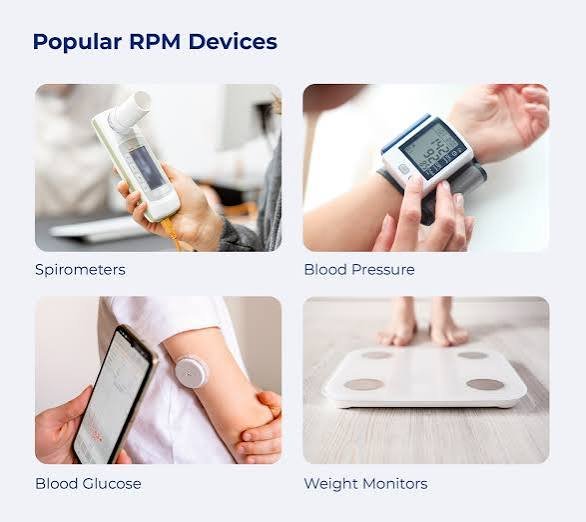
The exact devices used depend on the patient’s condition and the purpose of monitoring. Some programs may track blood pressure, blood glucose, heart rate, oxygen saturation, weight, temperature, or other measurements.
7 Powerful Benefits of Remote Patient Monitoring
1. Remote Patient Monitoring Supports Convenient Care
One of the biggest benefits of Remote Patient Monitoring is convenience. Patients may be able to collect certain health measurements from home instead of traveling to a clinic for every routine check.
This can be particularly useful for people who have difficulty traveling, live far from healthcare facilities, or require frequent monitoring.
Home-based monitoring can also make healthcare more flexible because information can be collected during normal daily life rather than only during occasional appointments.
2. Remote Patient Monitoring Helps With Regular Monitoring
Some health conditions require measurements over time rather than a single reading.
For example, one blood pressure measurement provides limited information compared with a series of measurements collected according to a healthcare professional’s instructions.
Remote monitoring can create a larger picture of how certain measurements change over time. This may help healthcare teams understand patterns and decide whether a treatment plan needs review.
However, the information still needs to be interpreted in the proper medical context.
3. Remote Patient Monitoring Can Support Earlier Attention
Another potential benefit is that changes in health measurements may become visible between regular appointments.
If a monitoring system identifies a concerning change, the healthcare team may be able to contact the patient and assess the situation sooner.
This does not mean that every unusual reading represents an emergency. Measurements can change for many reasons, including device errors, temporary conditions, activity, stress, or incorrect use.
Therefore, professional review remains important.
4. Remote Patient Monitoring Can Improve Patient Engagement
Using a monitoring device can help some patients become more aware of their health measurements.
When people regularly participate in their care, they may better understand how their health changes over time.
For example, a patient monitoring blood pressure may become more familiar with the importance of taking measurements correctly and following the care plan provided by a healthcare professional.
Still, technology should support the patient rather than create unnecessary pressure or anxiety.
5. Remote Patient Monitoring Can Reduce Unnecessary Visits
Regular monitoring from home may reduce the need for some routine in-person visits.
This can be useful when a healthcare professional only needs certain measurements to evaluate progress.
Reducing unnecessary travel can save time for patients and healthcare teams. It may also make healthcare services more accessible when clinics are busy.
However, remote monitoring cannot replace every physical examination or medical appointment.
6. Remote Patient Monitoring Supports Chronic Care
Long-term health conditions often require continued monitoring.
Remote systems can help healthcare teams follow selected measurements between appointments. This can provide additional information that may support ongoing care.
The approach can be especially useful when the healthcare team needs repeated measurements rather than occasional snapshots.
The technology should be selected according to the patient’s needs rather than simply because a device is available.
7. Remote Patient Monitoring Can Support More Personalized Care
Healthcare information collected over time can help clinicians understand how an individual patient responds to a treatment or lifestyle plan.
Instead of relying only on general information, a healthcare professional may have access to patient-specific measurements collected during everyday life.
This can support more informed discussions between patients and healthcare teams.
Personalized monitoring does not mean that technology makes medical decisions independently. Professional judgment remains an important part of safe healthcare.
5 Risks of Remote Patient Monitoring
1. Remote Patient Monitoring Can Create Privacy Concerns
Remote Patient Monitoring involves the collection and transmission of health information. Because health data is sensitive, privacy and security are important concerns.
Weak passwords, poorly protected devices, insecure connections, or inappropriate data handling can increase privacy risks.
Healthcare providers and technology companies therefore need strong security practices and clear rules for handling patient information.
Patients should also understand what information is being collected and how it is used.
2. Remote Patient Monitoring Depends on Technology
Not everyone has reliable internet access, a compatible smartphone, or the technical skills needed to use connected health devices.
Technical problems can also interrupt data transmission.
If a device stops working or information is not transferred correctly, healthcare professionals may not receive the expected measurements.
For this reason, monitoring programs need technical support and alternative procedures when technology fails.
3. Remote Patient Monitoring Can Produce Incorrect Data
A device can provide an inaccurate measurement if it is damaged, poorly maintained, incorrectly positioned, or used in the wrong way.
Even a high-quality device cannot guarantee a meaningful result if the measurement is taken incorrectly.
Patients should receive clear instructions about how and when to use monitoring equipment. Healthcare professionals should also consider the reliability and limitations of the device before making clinical decisions.
4. Remote Patient Monitoring Can Increase Data Overload
Continuous or frequent monitoring can produce a large amount of information.
More data does not always mean better healthcare. If healthcare professionals receive too many alerts or measurements, it can become difficult to identify which changes actually matter.
Effective monitoring therefore requires sensible thresholds, good software design, and clear clinical workflows.
5. Remote Patient Monitoring May Not Replace In-Person Care
A major limitation is that remote monitoring cannot provide every part of a physical medical examination.
Some problems require physical assessment, imaging, laboratory testing, procedures, or urgent treatment.
Therefore, remote monitoring should generally be viewed as an additional healthcare tool rather than a complete replacement for traditional medical care.
Remote Patient Monitoring Comparison Table
| Area | Potential Benefit | Main Risk |
|---|---|---|
| Home Monitoring | Greater convenience | Device-use errors |
| Blood Pressure Tracking | Repeated measurements | Incorrect readings |
| Glucose Monitoring | Regular data collection | Data interpretation issues |
| Wearable Devices | Continuous or frequent tracking | Battery or connectivity problems |
| Digital Health Platforms | Faster information sharing | Privacy concerns |
| Chronic Care | Long-term observation | Data overload |
| Patient Engagement | More participation | Technology fatigue |
Remote Patient Monitoring Technology and Development
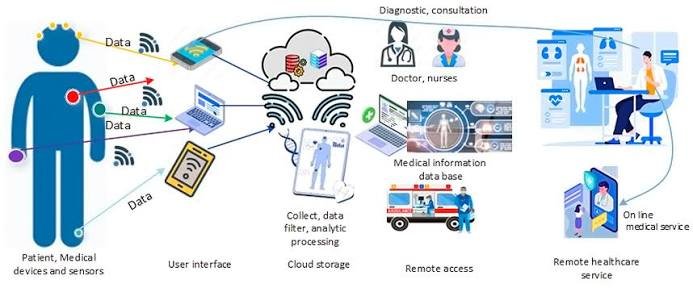
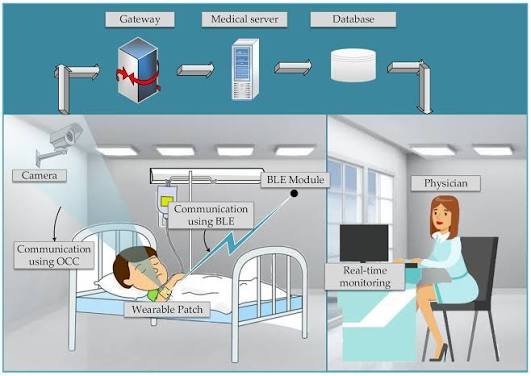
Modern monitoring systems can combine connected medical devices, mobile applications, cloud platforms, dashboards, and automated alerts.
A typical process may look like this:
Patient → Monitoring Device → Smartphone/Connection → Healthcare Platform → Healthcare Team
The device collects a measurement. The information is then transmitted through an available connection. A healthcare platform can organize the information so that authorized professionals can review it.
Some systems may also use automated analysis to identify unusual patterns. However, automated alerts should not automatically be treated as a diagnosis.
The quality of the complete system depends on the device, connectivity, software, data security, clinical workflow, and human review.
Remote Patient Monitoring Development Trend
The development of Remote Patient Monitoring is moving toward more connected and personalized healthcare systems.
A simple illustrative maturity model is shown below. These values are not market statistics or clinical measurements; they simply represent stages of technology development.
The direction is clear: monitoring is becoming more connected, but the technology still needs to remain simple enough for patients and useful enough for healthcare professionals.
Future of Remote Patient Monitoring
The future of Remote Patient Monitoring is likely to involve better connected devices, improved software, more personalized monitoring, and stronger integration with healthcare systems.
Wearable technology may become more useful for collecting selected health information during everyday activities. At the same time, artificial intelligence could help organize large amounts of health data and identify patterns for professional review.
Another important area is interoperability. Different healthcare devices and systems need to communicate effectively so that information can be used without unnecessary manual work.
However, future development should not focus only on collecting more data. The most useful systems will be those that provide reliable information at the right time while protecting patient privacy.
Affordability will also remain important. Advanced monitoring technology will have limited value if patients cannot access or use it easily.
FAQs About Remote Patient Monitoring
What is Remote Patient Monitoring?
Remote Patient Monitoring is a healthcare method that allows selected patient health information to be collected outside a traditional healthcare facility and shared with healthcare professionals for review.
What devices are used in Remote Patient Monitoring?
Depending on the care plan, devices may include blood pressure monitors, glucose meters, pulse oximeters, weight scales, wearable heart monitors, and other connected health devices.
Is Remote Patient Monitoring safe?
It can be a useful part of healthcare when appropriate devices, security measures, clinical procedures, and professional oversight are used. It does not eliminate all healthcare risks.
Can Remote Patient Monitoring replace doctors?
No. Remote monitoring can provide additional health information, but healthcare professionals are still needed to interpret information, assess patients, make clinical decisions, and provide treatment.
What is the biggest challenge of Remote Patient Monitoring?
One major challenge is making sure that collected information is accurate, secure, understandable, and clinically useful. Technology and connectivity problems can also affect monitoring.
Conclusion
Remote Patient Monitoring is creating new ways for healthcare teams to follow patients outside hospitals and clinics. Its potential benefits include greater convenience, regular monitoring, patient engagement, support for chronic care, and better access to health information between appointments.
At the same time, important risks remain. Privacy concerns, technology dependence, inaccurate measurements, data overload, and the limits of remote care need to be addressed carefully.
The future of remote monitoring will depend not only on better devices but also on secure systems, reliable data, simple patient experiences, and strong professional oversight. When these elements work together, remote monitoring can become a valuable part of modern healthcare.
Leave a Reply