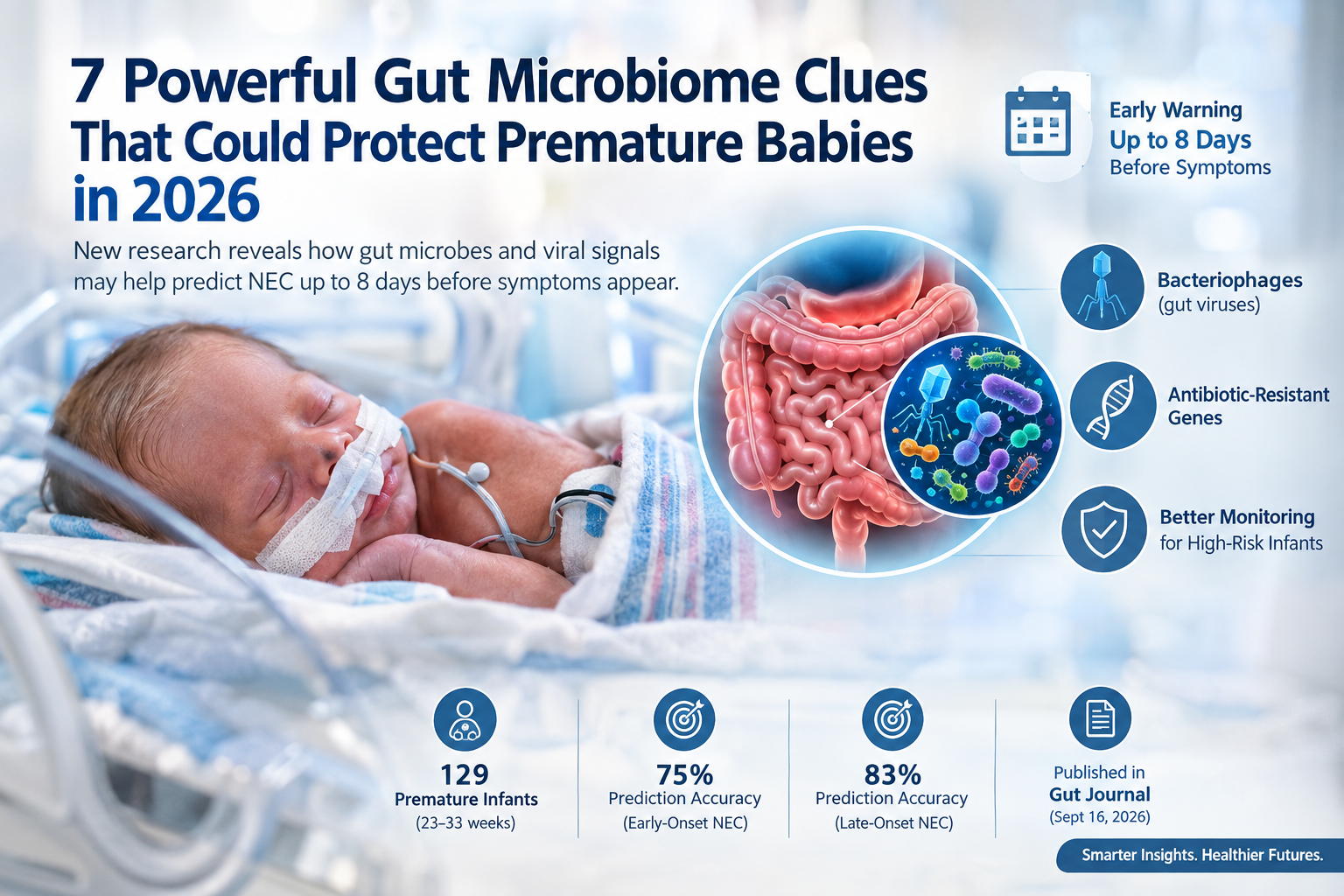
Premature babies are often exposed to serious health challenges because their organs and immune systems are still developing. Among these challenges, necrotizing enterocolitis (NEC) is considered one of the most dangerous intestinal conditions affecting premature infants. Now, an important research development has been reported on September 16, 2026, as researchers from Washington University School of Medicine in St. Louis identified new gut microbiome signals that may help predict NEC before visible symptoms appear.

The research has placed special attention on bacteria-infecting viruses, known as bacteriophages or phages, as well as bacterial antibiotic-resistance genes. Interestingly, these signals were found to provide an early warning window of up to eight days before clinical symptoms appeared. Therefore, 2026 Powerful Gut Microbiome Clues for Premature Babies may become an important research topic for understanding how earlier risk detection could eventually be developed.
Table of Contents
- What Is Necrotizing Enterocolitis?
- Why the Premature Baby Gut Matters
- 7 Powerful Gut Microbiome Clues
- How Researchers Found the Signals
- What the 2026 Findings Could Mean
- Antibiotic Resistance and NEC
- Could AI Improve Early Detection?
- Research Limitations
- Future Possibilities
- FAQ
- Conclusion
What Is Necrotizing Enterocolitis?
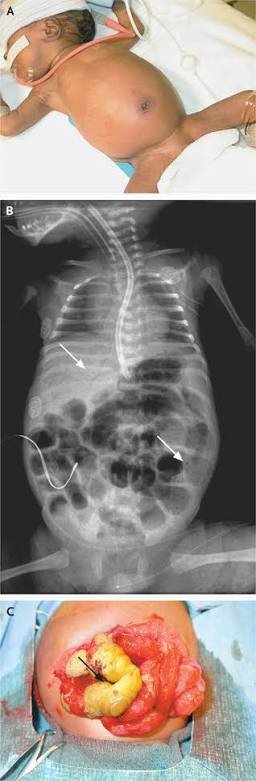
Necrotizing enterocolitis, commonly called NEC, is a serious inflammatory intestinal disease that mainly affects premature infants. In this condition, the immature intestinal lining can become severely inflamed, and blood flow to intestinal tissue can be reduced. As a result, sections of the intestine can become damaged.
Because the disease can progress rapidly, early recognition is considered extremely important. However, reliable prediction has historically been difficult. This is why the 2026 Powerful Gut Microbiome Clues for Premature Babies research has attracted attention.
According to the newly reported WashU Medicine study, the researchers were able to identify microbial signals associated with both early- and late-onset NEC.
Why the Premature Baby Gut Matters
The gut microbiome is made up of microorganisms and their genetic material living inside the digestive system. In premature babies, this microbial ecosystem is still developing and can be influenced by factors such as hospitalization, antibiotics, feeding, and immature immunity.
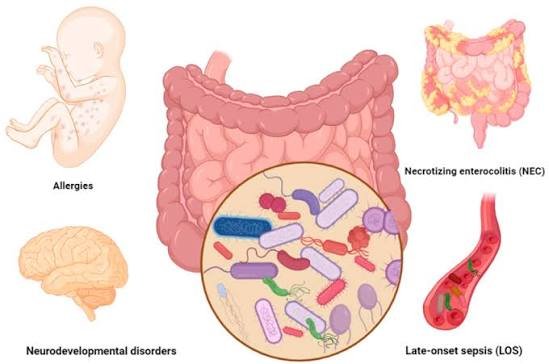
Therefore, changes in this ecosystem may provide information about the health of an infant before obvious clinical signs are noticed. The 2026 Powerful Gut Microbiome Clues for Premature Babies findings suggest that researchers may need to look beyond bacteria alone when studying NEC.
In particular, viruses that infect bacteria may provide additional information about what is happening inside the premature infant’s gut.
7 Powerful Gut Microbiome Clues
1. Bacteriophages May Provide an Early Warning
One of the most important findings involved bacteriophages, which are viruses that infect bacteria. Unlike viruses that directly infect human cells, phages primarily target bacterial cells.
In the new research, phage-related genetic signals were associated with early-onset NEC. Prediction models using these signals were able to identify infants who later developed the disease with approximately 75% accuracy, and the warning could appear up to eight days before clinical symptoms.
This makes 2026 Powerful Gut Microbiome Clues for Premature Babies particularly relevant because the study highlights a part of the microbiome that has received less attention in traditional NEC research.
2. Antibiotic-Resistance Genes Were Important
A second major clue was found in bacterial antibiotic-resistance genes. These genes can allow bacteria to survive exposure to certain antibiotics.
2026 Powerful Gut Microbiome Clues for Premature Babies The researchers found that late-onset NEC was associated with an accumulation of antibiotic-resistance genes in gut bacteria. This pattern was linked to cumulative antibiotic exposure during longer stays in neonatal intensive care units.
Thus, the 2026 Powerful Gut Microbiome Clues for Premature Babies findings may encourage researchers to examine not only which bacteria are present but also what genetic capabilities those bacteria carry.
3. Early-Onset and Late-Onset NEC May Differ
The study also suggested that early-onset and late-onset NEC may have different biological patterns.
Early-onset disease was associated more strongly with phage-bacterial interactions, while late-onset disease showed a stronger connection with the accumulation of antibiotic-resistance genes.
This distinction is important because NEC may not represent one identical biological process in every premature infant.
4. Stool Samples Could Carry Valuable Information
2026 Powerful Gut Microbiome Clues for Premature Babies The research was based on genetic information obtained from stool samples. This is significant because stool can provide a non-invasive way to study the intestinal environment.
The researchers analyzed existing genetic data from 129 premature infants, including 43 who developed NEC and 86 healthy premature infants. The babies had been born between 23 and 33 weeks of gestation.
Consequently, the 2026 Powerful Gut Microbiome Clues for Premature Babies research demonstrates how stored biological samples can be used to investigate disease patterns.
5. AI Prediction Models Were Used
Advanced computer algorithms were used to examine the genetic data and identify patterns associated with NEC risk. The models were designed to recognize combinations of phage sequences and antibiotic-resistance genes.
This does not mean that an AI system can currently diagnose NEC independently. Instead, the research demonstrates how computational methods can be used as research tools to identify potentially useful biological signals.
The 2026 Powerful Gut Microbiome Clues for Premature Babies findings therefore connect microbiome research with modern computational analysis.
6. An Eight-Day Warning Window Was Identified
2026 Powerful Gut Microbiome Clues for Premature Babies One of the most notable findings was the possibility of detecting risk before physical symptoms appeared. Early-onset NEC could be predicted up to eight days in advance with approximately 75% accuracy, while late-onset NEC prediction reached approximately 83% accuracy in the reported analysis.
Such a window could eventually be valuable if the findings are validated in larger and independent populations.
However, the 2026 Powerful Gut Microbiome Clues for Premature Babies results should not yet be interpreted as a clinically available prediction test. More research will be required before such an approach could be used routinely.
7. The Findings Could Open New Research Directions
The researchers suggested that phage biology could potentially be involved in other inflammatory or antibiotic-related illnesses as well. Conditions such as inflammatory bowel disease, sepsis, and drug-resistant bacterial infections were mentioned as possible areas for future investigation.
Therefore, the 2026 Powerful Gut Microbiome Clues for Premature Babies discovery may have implications beyond NEC research, although those broader possibilities remain investigational.
How Researchers Found the Signals
The research team examined genetic data obtained from stool samples collected from premature infants. Phage genomic sequences and antibiotic-resistance genes were reconstructed from bacterial genetic material.
2026 Powerful Gut Microbiome Clues for Premature Babies The information was then analyzed using computational prediction models. According to the researchers, the analysis showed that phage-bacterial interactions could act as early signals for early-onset NEC. Meanwhile, resistance-gene accumulation was associated with late-onset disease.
This approach demonstrates how microbiology, genomics, and computational analysis can be combined to study complex neonatal diseases.
The 2026 Powerful Gut Microbiome Clues for Premature Babies findings are especially notable because previous research had focused heavily on bacteria themselves, while the new study examined the viruses living within the bacterial ecosystem.
What the 2026 Findings Could Mean
The biggest potential benefit of this research would be earlier recognition of babies who may be at increased risk. NEC can develop quickly, so additional warning information could eventually help clinicians monitor vulnerable infants more closely.
However, it must be emphasized that the study does not establish a new treatment or guarantee that NEC can be prevented. Instead, a biological prediction signal has been identified that needs further validation.
The 2026 Powerful Gut Microbiome Clues for Premature Babies findings should therefore be viewed as an important research development rather than an immediately available medical screening test.
Antibiotic Resistance and NEC
Antibiotics are frequently used in neonatal intensive care because premature infants can be vulnerable to serious infections. However, antibiotic exposure can also influence the composition and genetic characteristics of the gut microbiome.
In the current study, accumulation of antibiotic-resistance genes was associated with late-onset NEC. This does not mean that antibiotics directly cause NEC in every premature infant. Rather, the researchers identified an association between resistance-gene accumulation and the disease pattern.
This distinction is important when discussing the 2026 Powerful Gut Microbiome Clues for Premature Babies because medical research findings should not be converted into treatment recommendations without clinical evidence.
Could AI Improve Early Detection?
AI and machine-learning methods are increasingly being used to analyze large biological datasets. In this study, computational models were used to recognize patterns within phage sequences and antibiotic-resistance genes.
The potential value of this approach comes from its ability to analyze many genetic features simultaneously. Nevertheless, AI predictions must be validated carefully before they are incorporated into clinical decisions.
The 2026 Powerful Gut Microbiome Clues for Premature Babies study provides an example of how AI-supported analysis could assist researchers in identifying patterns that might otherwise remain difficult to detect.
Research Limitations
Several limitations should be kept in mind. The study involved a relatively small group of premature infants, and the samples came from three neonatal intensive care units. Therefore, the findings will need to be tested in larger and more diverse populations.
In addition, prediction accuracy in a research dataset does not automatically translate into clinical usefulness. Independent validation, standardized testing, and prospective clinical studies would be needed before routine implementation could be considered.
The 2026 Powerful Gut Microbiome Clues for Premature Babies should consequently be described as promising research clues rather than a confirmed clinical solution.
Future Possibilities
Future studies may investigate whether these microbial signals can be combined with other information, including gestational age, feeding patterns, antibiotic exposure, clinical observations, and other laboratory measurements.
If the signals continue to perform well in larger studies, a future risk-assessment system could potentially be developed. Such a system might help clinicians identify infants requiring closer observation.
However, more evidence is required before that possibility can be considered established. The 2026 Powerful Gut Microbiome Clues for Premature Babies research has opened a promising direction, but the path from discovery to clinical use remains substantial.
Simple Research Snapshot
| Research Finding | Reported Result |
|---|---|
| Early-onset NEC prediction | Approximately 75% accuracy |
| Late-onset NEC prediction | Approximately 83% accuracy |
| Potential warning period | Up to 8 days |
| Main biological signals | Phages and antibiotic-resistance genes |
| Infant group studied | 129 premature infants |
| Research publication | Gut, September 16, 2026 |
The figures above are from the reported WashU Medicine study and should not be interpreted as performance of an approved clinical diagnostic test.
FAQ
What is the main finding of this new research?
The study found that bacteriophages and bacterial antibiotic-resistance genes in the gut microbiome may help predict necrotizing enterocolitis in premature infants before clinical symptoms appear.
How early could NEC risk be predicted?
The reported models identified risk signals up to eight days before symptoms appeared. Early-onset NEC prediction was approximately 75% accurate, while late-onset prediction reached approximately 83% accuracy in the study.
Is this a new treatment for premature babies?
No. The research identifies potential predictive biomarkers. It does not establish a new treatment or prevention method.
What are bacteriophages?
Bacteriophages, or phages, are viruses that infect bacteria. They can influence bacterial communities and can sometimes carry or affect genes associated with bacterial traits such as antibiotic resistance.
Can parents use this research to test their baby at home?
No. The findings are from research and should not be used as a home diagnostic method. Medical decisions involving premature infants should be made by qualified neonatal clinicians.
Why is this research important?
Earlier identification of NEC risk could eventually provide clinicians with additional time to monitor vulnerable infants and investigate appropriate interventions. However, further validation is required.
Conclusion
The new research published on September 16, 2026, has provided a fresh perspective on necrotizing enterocolitis in premature babies. Instead of focusing only on bacteria, researchers examined bacteriophages and antibiotic-resistance genes within the gut microbiome. These signals were associated with NEC risk before symptoms became visible.
The 2026 Powerful Gut Microbiome Clues for Premature Babies findings are promising because an early warning period of up to eight days was identified in the study. Nevertheless, the research remains an important scientific step rather than an approved diagnostic solution.
As larger studies are conducted, the role of gut viruses, bacterial resistance genes, and computational prediction may become clearer. Ultimately, the 2026 Powerful Gut Microbiome Clues for Premature Babies could help guide future research into earlier recognition of NEC and other microbiome-related diseases.
Leave a Reply