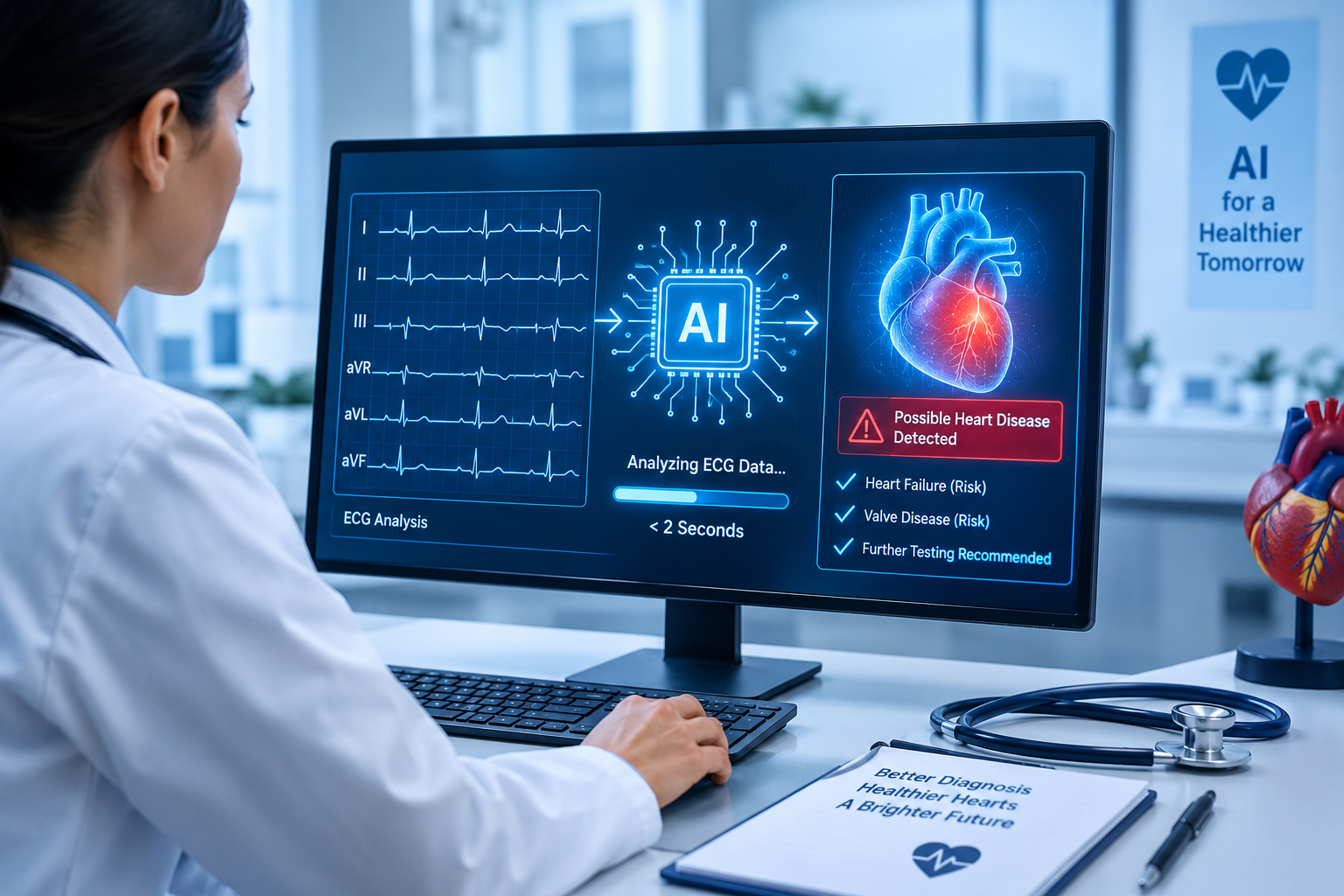
Heart disease continues to be one of the world’s most serious health challenges, but a remarkable development in artificial intelligence could make early detection faster and more efficient. The 2026 Powerful AI Heart Disease Breakthrough uses information collected from a routine electrocardiogram, commonly known as an ECG. Researchers have developed an artificial intelligence system that can identify hidden signs associated with heart failure and heart valve disease from ECG data. The technology could eventually help doctors identify high-risk patients more quickly and prioritize them for further cardiac testing. (bhf.org.uk)
2026 Powerful AI Heart Disease Breakthrough The research was led by researchers at Imperial College London and supported by the British Heart Foundation. The findings were presented at the European Society of Cardiology Congress in Munich. The system was trained using millions of ECG recordings and was later tested on more than 65,000 ECGs from hospital patients in the United States. In testing, the AI identified up to 81% of patients with reduced heart-pumping function and up to 90% of patients with a common form of heart valve disease. (bhf.org.uk)
What Is the 2026 Powerful AI Heart Disease Breakthrough?
The 2026 Powerful AI Heart Disease Breakthrough works by analyzing subtle patterns inside an ECG that may not be easily recognized by the human eye. An ECG records the electrical activity of the heart and has been used for many years to examine heart rhythm and identify certain cardiac problems.
2026 Powerful AI Heart Disease Breakthrough Traditionally, an ECG is not enough to diagnose many structural heart conditions. For problems such as reduced heart-pumping function or valve disease, patients may need an echocardiogram, which is an ultrasound scan of the heart. In some healthcare systems, patients can face significant waiting times before receiving this additional examination.
2026 Powerful AI Heart Disease Breakthrough The new AI technology could potentially change that process. Instead of requiring every patient to immediately undergo advanced imaging, an AI system could analyze an existing ECG and identify people who appear more likely to have an underlying cardiac condition.
However, it is important to understand that the technology is not being presented as a replacement for doctors or a definitive diagnostic test. Rather, it could become a screening and decision-support tool.
How Does AI Analyze an ECG?
An ECG contains electrical signals generated by the heart. These signals create patterns that can provide information about heart rate, rhythm, and other cardiac characteristics.
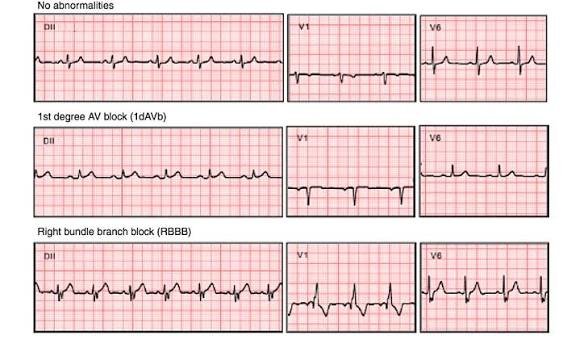
2026 Powerful AI Heart Disease Breakthrough The human eye can identify many important ECG abnormalities, but artificial intelligence can analyze enormous amounts of information simultaneously. During development, the researchers provided the AI with millions of ECG recordings together with clinical information. The system was then trained to recognize relationships between ECG patterns and specific heart conditions. (bhf.org.uk)
2026 Powerful AI Heart Disease Breakthrough Researchers also used 72,475 ECGs linked to scans showing the structure and function of the heart. This helped the model learn which electrical patterns were associated with conditions such as reduced heart-pumping function and valve disease. (bhf.org.uk)
Consequently, when a new ECG is analyzed, the AI can search for subtle characteristics that may indicate a potential problem. This process can be completed extremely quickly, which is one of the most exciting aspects of the research.
Why Less Than Two Seconds Matters
The speed of the 2026 Powerful AI Heart Disease Breakthrough is particularly important because early identification can influence what happens next.
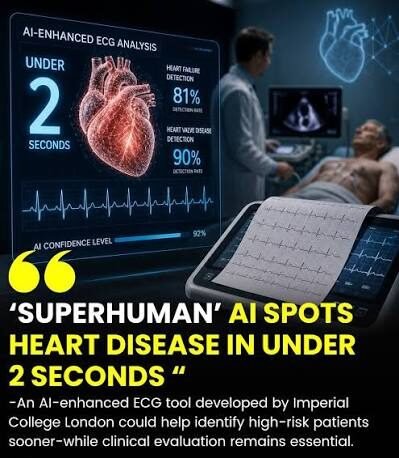
A patient with an elevated risk could potentially be referred for an echocardiogram more quickly. In turn, this could reduce delays in identifying certain heart conditions and allow appropriate treatment or monitoring to begin sooner.
2026 Powerful AI Heart Disease Breakthrough The British Heart Foundation notes that around one billion ECGs are performed worldwide every year. Because ECGs are already widely available, adding AI analysis could potentially increase the amount of information obtained from a test that is already part of routine healthcare. (bhf.org.uk)
This does not mean that every ECG would suddenly become a complete heart examination. Instead, the technology could provide doctors with an additional warning signal that may help determine which patients require further investigation.
What Did the Research Find?
The findings are encouraging. Researchers tested the AI on a small group of 5,442 patients and a larger group of 61,520 patients in the United States. The system was assessed for its ability to identify reduced left ventricular ejection fraction, thickening of the heart muscle, and moderate or more severe heart valve disease. (bhf.org.uk)
For reduced heart-pumping function, the AI correctly identified 77% of affected patients in the smaller group and 81% in the larger group.
The results for aortic stenosis, a common heart valve condition, were also notable. The AI correctly identified 90% of affected patients in the smaller group and 80% in the larger group. (bhf.org.uk)
These numbers show why the 2026 Powerful AI Heart Disease Breakthrough has attracted attention from researchers and healthcare professionals.
Nevertheless, these results should not be interpreted as meaning that the AI can detect every heart condition in every patient. Performance can vary according to the patient population, disease prevalence, and clinical setting.
Could This Help Patients Get Diagnosed Earlier?
One of the biggest potential advantages of the technology is earlier identification.
2026 Powerful AI Heart Disease Breakthrough Some forms of heart disease can develop gradually. A person may have relatively mild symptoms or no obvious symptoms at all. As a result, the underlying condition may remain unnoticed until it becomes more serious.
2026 Powerful AI Heart Disease Breakthrough If an AI system identifies a suspicious ECG pattern, the patient could potentially be prioritized for additional testing. An echocardiogram could then be used to determine whether a structural heart problem is actually present.
The researchers have highlighted the possibility that patients at higher risk could be fast-tracked for heart ultrasound examinations. This could be especially useful where specialist appointments or imaging services are limited. (bhf.org.uk)
Therefore, the 2026 Powerful AI Heart Disease Breakthrough could eventually become an important part of a faster screening pathway.
AI Does Not Replace Medical Professionals
Despite the excitement surrounding the technology, AI should not be viewed as a replacement for cardiologists or other qualified healthcare professionals.
An AI prediction is not the same as a medical diagnosis. A patient may receive a high-risk result even when no serious disease is present, which is known as a false positive. Similarly, some genuine cases could be missed.
For this reason, AI results would need to be considered alongside symptoms, medical history, physical examination, ECG interpretation, and additional diagnostic tests.
The British Heart Foundation has also emphasized that the technology cannot currently be used on its own to definitively diagnose or rule out heart failure or heart valve disease. (bhf.org.uk)
This distinction is extremely important. The technology may help doctors decide who should be investigated more closely, rather than independently deciding who has heart disease.
What Makes This Technology Different?
Traditional ECG interpretation depends heavily on established clinical knowledge and visible electrical patterns. AI, on the other hand, can examine complex relationships across large datasets.
The 2026 Powerful AI Heart Disease Breakthrough works because the system is designed to identify information hidden within ECG signals. Researchers believe that some of these signals are difficult for humans to recognize without computational assistance.
This could potentially transform the role of the ECG. Instead of being used mainly for rhythm-related problems and other established indications, an AI-enhanced ECG could provide additional clues about the structure and function of the heart.
The possibility is especially significant because ECG machines are already available in many hospitals, clinics, and medical centers.
What Are the Limitations?
Although the research is promising, several limitations must be considered.
First, the system has mainly been evaluated using specific patient datasets. AI models can perform differently when they are moved from one healthcare environment to another. Differences in patient demographics, medical history, equipment, and disease prevalence can affect performance.
Second, the AI does not provide a complete picture of a patient’s cardiovascular health. Heart disease includes many different conditions, and a model designed to identify certain forms of heart failure or valve disease should not be assumed to identify every cardiovascular problem.
Third, additional testing remains necessary. If the AI flags a patient as potentially high-risk, the result would need to be confirmed through appropriate medical evaluation.
Therefore, the 2026 Powerful AI Heart Disease Breakthrough should currently be understood as a promising research development rather than a universal diagnostic solution.
When Could It Be Used in Routine Healthcare?
The technology is already being tested further. According to the British Heart Foundation, researchers are testing the AI on ECGs from 590 NHS patients in London and Bristol. The team has suggested that the technology could potentially be around two years away from routine use, although further evaluation will be required. (bhf.org.uk)
2026 Powerful AI Heart Disease Breakthrough This next stage is important because researchers need to determine how well the system works in real-world NHS patients rather than relying only on previous datasets.
If the results remain positive, regulatory review, clinical validation, healthcare integration, and professional training would still be necessary before widespread implementation.
The Future of AI in Heart Health
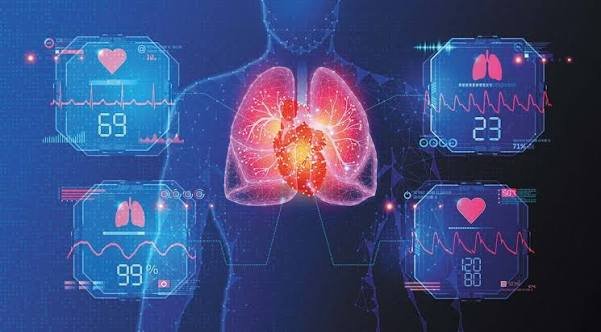
The development of AI-powered ECG analysis represents a broader shift toward technology-assisted healthcare. Artificial intelligence is increasingly being investigated for medical imaging, disease prediction, patient monitoring, and personalized treatment.
In cardiovascular medicine, AI could potentially help doctors process large amounts of information more efficiently. Instead of replacing human expertise, the technology may provide additional information that supports clinical decision-making.
The 2026 Powerful AI Heart Disease Breakthrough demonstrates how an existing medical test could potentially become more informative through artificial intelligence.
In the future, similar systems might be integrated into portable ECG devices, primary-care clinics, emergency departments, and remote healthcare services. If properly validated, this could make advanced screening more accessible to people who have limited access to specialist cardiac services.
Frequently Asked Questions
Can AI detect heart disease from an ECG?
AI can identify patterns in ECG signals associated with certain heart conditions. Recent research has shown that the system can identify signs associated with reduced heart-pumping function and some forms of heart valve disease. However, further medical testing is still required for diagnosis. (bhf.org.uk)
How quickly can the AI analyze an ECG?
The research indicates that the AI can analyze relevant ECG information in less than two seconds. This speed is one of the major reasons the technology could be useful as a future screening tool. (bhf.org.uk)
Does the AI replace a cardiologist?
No. The system is intended to support healthcare professionals. An AI result should be interpreted alongside a patient’s symptoms, history, examination, and other diagnostic tests.
What types of heart disease can it detect?
The research focused particularly on reduced heart-pumping function and heart valve disease, including aortic stenosis. The system is not designed to diagnose every possible cardiovascular condition. (bhf.org.uk)
Is this technology available for everyone?
Not yet as a routine diagnostic service. Further testing is being conducted, including evaluation in NHS patients, before the technology could potentially be introduced into everyday healthcare. (bhf.org.uk)
Conclusion
The 2026 Powerful AI Heart Disease Breakthrough represents a promising step toward faster and smarter cardiovascular screening. By examining subtle information hidden inside routine ECG recordings, artificial intelligence could help identify patients who may need additional heart testing.
2026 Powerful AI Heart Disease Breakthrough The research is particularly encouraging because ECGs are already widely used and relatively accessible. Instead of introducing an entirely new test, AI could potentially make an existing test more informative.
At the same time, caution is essential. The technology cannot currently replace professional diagnosis, and its results must be confirmed through appropriate medical evaluation. Further real-world research will be needed to determine how accurately it performs across different populations and healthcare settings.
If future studies confirm its benefits, AI-assisted ECG analysis could help doctors identify high-risk patients sooner, prioritize additional testing, and potentially reduce delays in cardiovascular care. For now, however, the 2026 Powerful AI Heart Disease Breakthrough remains an exciting research development that shows how artificial intelligence could contribute to the future of heart health.
Leave a Reply